

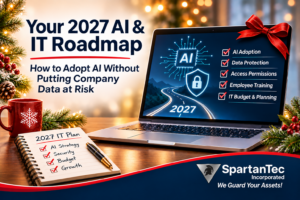
Prepare your business for 2027 with a secure AI adoption strategy that protects sensitive data and supports business growth.
Artificial intelligence is changing the way businesses work. From drafting emails and summarizing meetings to analyzing information and simplifying everyday tasks, AI offers opportunities to save time, improve productivity, and support business growth.
But as you prepare for 2027, there’s an important question to consider:
How can your organization take advantage of AI without compromising the information you’ve worked so hard to protect?
For businesses and organizations across North and South Carolina, the answer starts with having a plan. You don’t need to become an AI expert or completely change how your business operates. You simply need the right tools, safeguards, and strategy to move forward with confidence.
Your Employees May Already Be Using AI
Even if your organization hasn’t officially introduced AI, your employees may already be using it.
An employee might use an AI tool to rewrite a client email, summarize a contract, review a financial report, or prepare a presentation. Their intentions are good. They’re looking for ways to work more efficiently.
However, without clear guidelines, employees may unknowingly share sensitive information with platforms that have not been approved by your organization.
This could include:
- Confidential client information
- Employee and personnel records
- Financial statements and tax documents
- Legal agreements and contracts
- Proprietary business information
- Customer and donor records
Depending on the platform and its settings, that information could be retained, processed, or used in ways your organization did not intend. As we discussed in our previous article, Your Employees Are Already Using AI. What Information Are They Giving It?, understanding how your employees are currently using AI is an important first step in developing a strategy that protects your business while encouraging productivity.
The goal isn’t to discourage employees from using AI. It’s to give them a safer way to use it.
Not All AI Tools Protect Your Information the Same Way
There is an important difference between using a personal AI account and using a business AI solution designed with organizational security in mind.
Business-grade AI solutions, including Microsoft 365 Copilot, ChatGPT Business, Google Gemini for Workspace, and Claude for Enterprise, can offer enhanced security, data privacy, access controls, and administrative oversight when appropriately licensed and configured.
There are also business-grade AI platforms that provide employees with access to multiple AI models through a centralized environment. These solutions can give organizations greater flexibility in how they use AI while helping maintain control over company information, employee access, and AI usage.
However, purchasing a business AI subscription does not automatically eliminate every security risk.
The joint cybersecurity guidance on AI Data Security: Best Practices for Securing Data Used to Train and Operate AI Systems, developed by the NSA, CISA, FBI, and other cybersecurity agencies, reinforces the importance of protecting sensitive information throughout the use of AI.
Before introducing an AI platform, your organization should understand:
- How the platform handles company information
- Whether submitted data is used to train AI models
- How information is stored and retained
- Who can access the information
- What security and administrative controls are available
- Whether the platform supports your organization’s compliance requirements
Choosing the right AI solution is about more than its capabilities. It’s also about how well it protects your business.
Before You Introduce AI, Know Who Has Access to What
Imagine an employee asking an AI assistant to summarize information about your organization’s upcoming budget.
If that employee already has access to confidential financial documents they shouldn’t be able to see, an AI assistant connected to those documents could make that information much easier to discover.
The underlying problem isn’t necessarily the AI tool. It’s the existing access permissions.
Over time, businesses accumulate shared folders, outdated user accounts, unnecessary permissions, and documents that may be accessible to more employees than intended.
The joint cybersecurity guidance on Deploying AI Systems Securely emphasizes the importance of establishing appropriate access controls when implementing AI. Regardless of which AI platform your organization chooses, understanding who has access to sensitive information and what information your AI tools can retrieve is an important step in protecting your business.
Before introducing AI into your workplace, consider reviewing:
- Employee access to shared files and folders
- Microsoft 365, SharePoint, Google Workspace, and other cloud storage and collaboration platform permissions
- Access to sensitive financial, personnel, and client information
- Accounts belonging to former employees
- External file-sharing settings
- Multifactor authentication and account security
Addressing these issues before implementing AI can help prevent existing security gaps from becoming larger problems.
Create an AI Policy Your Employees Can Actually Follow
An AI usage policy doesn’t need to be a lengthy document filled with technical terminology.
It should clearly explain what employees can do, what they should avoid, and where they can go when they have questions.
A practical AI policy should address:
- Which AI tools are approved for business use
- What information can and cannot be entered into AI platforms
- When employees should review and verify AI-generated content
- How AI can be used when working with confidential information
- Who employees should contact with questions or concerns
The National Institute of Standards and Technology (NIST) provides an AI Risk Management Framework that organizations can use as a resource for developing responsible AI practices and managing potential risks.
Employee education is equally important. Your team should understand why these guidelines exist and how to use AI responsibly. Understanding the risks associated with unapproved AI tools is also an important part of employee education. Our article, Shadow AI: The AI Tools Your Employees Are Hiding From You, explores why businesses need greater visibility into the AI tools being used in their workplace.
AI can produce inaccurate information, misinterpret instructions, or generate content that sounds convincing but is incorrect. Human oversight remains essential, particularly when making financial, legal, operational, or client-related decisions.
Build AI Into Your 2027 IT Budget
As you finalize your technology budget for 2027, consider where AI fits into your organization’s overall business strategy.
Rather than purchasing new technology simply because it’s available, identify where it can solve real problems or improve existing processes.
Your 2027 IT roadmap should consider:
AI software and licensing: Identify which tools your employees need and which subscriptions provide meaningful value.
Data security and access management: Ensure your organization has the appropriate safeguards in place before expanding AI usage.
Employee training: Give your team the knowledge and confidence to use AI effectively and responsibly.
Technology infrastructure: Evaluate whether your current systems, devices, and cloud platforms can support your future needs.
Ongoing IT support and oversight: Plan for regular reviews, security monitoring, and adjustments as your organization and AI capabilities evolve.
A well-developed IT roadmap helps you prioritize investments, anticipate expenses, and reduce unexpected technology costs throughout the year.
As we discussed in our recent article, This Thanksgiving, Be Thankful for the Problems That Never Happened, proactive technology management can help prevent disruptions before they affect your business. The same approach applies to preparing your organization for AI adoption.
Start Small, Measure Results, and Scale Safely
Your organization doesn’t need to implement AI across every department on January 1.
Start by identifying everyday tasks that consume valuable employee time and can be improved without introducing unnecessary risk.
Some practical starting points include:
- Drafting routine business communications
- Creating internal training materials
- Developing document templates
- Brainstorming marketing ideas
- Organizing nonconfidential meeting notes
- Creating checklists and standard operating procedures
Once your team becomes comfortable using approved AI tools, evaluate the results.
Are employees saving time? Are processes becoming more efficient? Is the quality of work improving? Are security guidelines being followed?
Use those answers to determine where AI can provide additional value.
The objective isn’t to use AI everywhere. It’s to use it where it makes sense for your business.
Make 2027 the Year Technology Works Smarter for Your Business
AI presents an exciting opportunity for businesses, but successful adoption starts with preparation, not simply purchasing another software subscription.
Having a clear understanding of your technology, security risks, business priorities, and budget can help you make more informed decisions about where AI belongs in your organization.
At SpartanTec, we help businesses and organizations throughout North and South Carolina develop practical technology strategies that align with their goals. From evaluating secure AI solutions and reviewing data permissions to developing technology roadmaps and predictable IT budgets, we help you prepare for what’s next.
You don’t have to figure it all out on your own.
Book a Q1 2027 IT & AI Strategy Session
Let’s discuss where your business is today, where you want to go in 2027, and how technology can help you get there securely.
SpartanTec, Inc.
We Guard Your Assets!
Frequently Asked Questions About AI Adoption
How can small businesses use AI securely?
Small businesses can use AI more securely by selecting approved business-grade tools, reviewing data access permissions, establishing clear usage policies, training employees, and maintaining appropriate cybersecurity protections.
Are business-grade AI tools safe for confidential business information?
Business-grade AI solutions such as Microsoft 365 Copilot, ChatGPT Business, Google Gemini, Claude, and centralized business AI platforms can offer enhanced data protection and administrative controls. However, their suitability for confidential information depends on licensing, configuration, data retention policies, access permissions, and organizational requirements. Businesses should evaluate these factors before introducing AI into sensitive workflows.
Does my business need an AI usage policy?
Yes. Even if your organization has not officially adopted AI, employees may already be using it. An AI usage policy establishes clear expectations and helps reduce the risk of unintentionally exposing sensitive information.
How do I choose the right AI platform for my business?
Start by identifying what you want AI to accomplish for your business. Consider your existing technology, employee needs, data security requirements, compliance obligations, and budget. The right solution may be an AI assistant integrated into your existing software or a centralized business AI platform that provides access to multiple AI models within a managed environment.
What should businesses include in their 2027 IT roadmap?
A 2027 IT roadmap should address cybersecurity, AI adoption, technology infrastructure, software licensing, employee training, business continuity, compliance requirements, and anticipated technology investments.
Can AI improve productivity without compromising data security?
Yes. With appropriately selected tools, properly configured access controls, employee training, and ongoing oversight, businesses can improve productivity while reducing the risks associated with AI adoption.

