

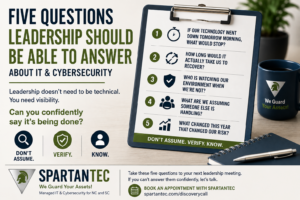
If I sat down with your leadership team tomorrow and asked five basic questions about your technology and cybersecurity, how many could they answer confidently?
I’m not talking about technical questions.
I wouldn’t ask how your firewall is configured, what version of endpoint protection you’re running, or how your backups are set up.
I’d ask questions like:
- What stops if your technology goes down tomorrow?
- How long would it actually take to get it back?
- Who is watching when nobody is in the office?
Those are leadership questions.
And the answers shouldn’t be based on what you assume is happening.
Not what you believe your IT provider is handling. Not what someone remembers discussing six months ago. Not what everyone thinks somebody else is doing.
Can you confidently say it’s being done?
Leadership doesn’t need to do the technical work. But leadership should know what the organization is depending on, who is responsible for it, and whether the important things are actually being done.
What IT and Cybersecurity Questions Should Leadership Be Able to Answer?
1. If our technology went down tomorrow morning, what would stop?
Could employees work? Could customers reach you? Could you invoice? Access files? Process payments? Teach classes? Provide public services?
Leadership doesn’t need a technical recovery plan memorized. But it should know which parts of the organization cannot operate without technology and which functions could continue manually.
We looked at this more closely earlier in the September series in What Would 48 Hours Without Technology Cost Your Organization?.
2. How long would it actually take us to recover?
“We have backups” is not a recovery time.
Ask when something was last restored successfully. Ask which systems would come back first. Ask whether recovery means two hours, eight hours, two days, or longer.
There is a big difference between having data backed up and knowing how quickly the organization can operate again.
3. Who is watching our environment when we’re not?
Cybersecurity problems don’t limit themselves to business hours. Leadership should know whether important security alerts are monitored after hours, who receives them, and – most importantly – whether someone is expected to take action.
Receiving an alert and responding to an alert are two different things.
4. What are we assuming someone else is handling?
This may be one of the most important questions on the list.
An internal employee thinks the IT provider handles it. The IT provider believes a software vendor handles it. Leadership assumes somebody is monitoring it.
Everyone thinks it’s covered.
But can anyone confidently say it’s being done?
Backups, Microsoft 365, cybersecurity monitoring, patching, employee training, vendor management, incident response, AI use, and documentation are all areas where responsibilities can become unclear.
If something matters to the organization, there should be a clear owner – and a way to verify it’s being done.
5. What changed this year that changed our risk?
Did you add employees? Open another location? Move something to the cloud? Start using AI? Add a major customer? Change vendors? Buy new software? Face new compliance requirements? Renew cyber insurance?
Technology risk doesn’t stand still.
If the organization changed but the technology and cybersecurity plan didn’t, that’s worth discussing.
These Five Questions Tell You More Than You Might Think
We’ve spent September looking at several different technology issues, but they’re really connected.
- We started by asking how much leadership really knows about its IT environment.
- Then we looked at what 48 hours without technology could cost.
- We talked about employees using AI tools leadership may not even know about.
- And we looked at whether organizations can prove the cybersecurity controls they’re representing on cyber insurance applications.
Different topics. Same underlying issue:
Visibility.
Leadership cannot manage every technical detail – and shouldn’t try to. But leadership does need enough visibility to know what matters, who is responsible, what is being protected, and what happens when something goes wrong.
Good IT Should Make These Questions Easier to Answer
Asking these questions isn’t about looking for problems with your IT department or current provider.
Good technology management should make the answers easier to find.
Responsibilities should be clear. Important systems should be documented. Recovery expectations should be understood. Security monitoring should have an owner. Leadership should have regular conversations about what’s changing.
If those things are happening, these five questions should be relatively easy to answer.
If they’re not, you’ve identified a good place to start.
For organizations that want outside support, SpartanTec provides managed and co-managed IT services as well as SecureGuard360 cybersecurity services. The goal is the same: clearer responsibility, better visibility, and technology that supports the organization the way leadership expects it to.
How Many Could You Answer Confidently?
Take these five questions to your next leadership meeting. Don’t prepare for them first. Just ask them.
If your team can answer all five clearly, that’s a good sign.
If one or two answers are “I think we’re doing that,” “I’m not sure,” or “we’d have to ask IT,” keep asking.
- Who owns it?
- How is it being done?
- When was it last checked?
- How do we know?
There is an important difference between assuming you’re protected and knowing the right things are actually being done.
SpartanTec can help you have that conversation in plain language and determine whether your current technology approach supports the organization the way leadership expects it to. Book an appointment with SpartanTec.
Don’t Assume. Verify. Know.
Frequently Asked Questions
What IT and cybersecurity questions should business leaders ask?
Leadership should be able to explain what would stop if technology failed, how quickly important systems could recover, who monitors cybersecurity activity, who owns critical technology responsibilities, and what changes have affected technology risk.
Does leadership need to understand technical cybersecurity details?
No. Leadership needs enough visibility to understand business risk, responsibilities, recovery expectations, and whether important controls and services are actually being managed.
How can leadership verify that IT and cybersecurity responsibilities are being handled?
Start by identifying the owner of each important responsibility, then ask how the work is performed, when it was last checked or tested, and what documentation or reporting confirms it is being done.
How often should leadership review IT and cybersecurity?
A formal review at least annually is a useful baseline, with additional reviews when the organization experiences significant growth, technology changes, insurance renewal, new compliance requirements, new AI use, or major operational changes.
What should be included in an IT strategy review?
A practical review can include cybersecurity, reliability, support, aging technology, cloud services, backups, recovery, employee needs, business priorities, budget, documentation, responsibilities, and upcoming projects.
What is co-managed IT?
Co-managed IT combines an organization’s internal IT resources with outside expertise, tools, monitoring, cybersecurity, project assistance, or support. Responsibilities are divided based on what the organization needs.
Related Reading

