
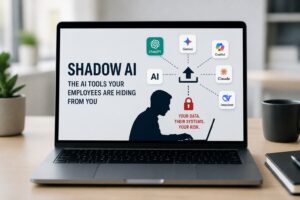
Shadow AI is the use of artificial intelligence tools, like ChatGPT, Copilot, Gemini, Claude, or DeepSeek, by employees without their employer’s knowledge or approval. In 2026, the majority of knowledge workers use these tools on the job, and most of their employers have no idea. The danger is not the AI itself. It is the customer data, financial records, and proprietary information employees are pasting into public chatbots that have no obligation to protect it, and the new laws that now hold the business responsible when that data walks out the door.
What Is Shadow AI?
Shadow AI is any AI tool an employee uses for work without IT approval, oversight, or a company account. It is the 2026 version of the personal Dropbox problem, except the stakes are higher because employees are not just storing files in these tools, they are feeding them confidential business data and asking the AI to read, summarize, or rewrite it.
The pattern is usually the same. An employee discovers a free chatbot helps them write faster. They start pasting in customer emails, then contracts, then financial spreadsheets to “save time.” The tool is convenient, the data flows out, and nobody in IT ever sees it. By the time leadership learns, the habit is months old and the data is already gone.
Why This Is Suddenly Everywhere
Two forces collided in 2026. AI tools became genuinely useful, and they became free or nearly free. The result is that employees adopted them faster than IT departments could keep up.
The 2026 numbers are striking:
| Metric | 2026 Reality | What It Means for You |
| Employees using unauthorized AI at work | Roughly 6 to 8 in 10 | Most of your team is already doing this |
| Share of AI data inputs that are sensitive | About 35%, up from 11% two years ago | Employees are pasting in real business data |
| Organizations that have had a breach tied to shadow AI | About 1 in 5 | This is not a hypothetical risk anymore |
| Added cost of a breach when shadow AI is involved | About $670,000 on top of the average | The financial hit is measurably worse |
| Organizations with a formal AI usage policy | Fewer than 4 in 10 | Most businesses have no rules at all |
The uncomfortable truth for Carolina business owners: if you have not explicitly told your team what AI they may use and what data they may share, the safest assumption is that they are using something, somewhere, and sharing more than you would allow if you knew.
What Data Is Actually Leaking
This is the part that surprises most owners. It is not just marketing copy and meeting notes. Employees are pasting in:
- Customer data and personal information (names, contact details, account numbers)
- Proprietary source code (the single most common exposure type)
- Financial records, projections, and business intelligence
- Internal strategic documents and product roadmaps
- API keys, passwords, and credentials (often by accident)
- Meeting recordings and transcripts
Once that data is pasted into a public chatbot, it leaves your control. The tool’s terms of service, not your policies, govern what happens next. Some tools retain prompts for training. Some share conversation links that get indexed by search engines. Some suffer their own breaches. The data is out, and you cannot call it back.
Real Incidents That Made the News
Shadow AI is not a future risk. It has already cost real companies real money.
- Samsung (2023): Three engineers pasted proprietary semiconductor source code into ChatGPT in a three-week span. Samsung banned the tool company-wide, then later resumed use with governance after employees demanded it back.
- OmniGPT (2025): An AI aggregator exposed 34 million chat lines to the dark web, including business documents, medical records, and API keys from over 30,000 user accounts.
- CISA (2026): The interim director of the U.S. cyber security agency uploaded files marked “For Official Use Only” to a public chatbot, triggering an internal security review.
- An Australian contractor (2025): Pasted the personal information of roughly 3,000 flood-affected homeowners into ChatGPT. Nobody noticed for six months.
The lesson is the same in every case: smart, well-meaning employees used a convenient tool to do their jobs faster, and the data left the building. None of these were malicious. All of them were preventable with a clear policy and a sanctioned alternative.
The Regulatory Hammer Is Coming
Until 2026, shadow AI was mostly a data-loss risk. Now it is also a legal one.
- The EU AI Act is in active enforcement, with penalties up to 35 million euros or 7% of global revenue for the most serious violations. If your business touches European customers or data, you are in scope.
- S. state laws are multiplying fast. California, Texas, Colorado, and Illinois all have new AI regulations taking effect in 2026, covering everything from training data transparency to algorithmic discrimination in hiring.
- The NIST AI Risk Management Framework is the emerging voluntary standard U.S. regulators and insurers expect businesses to follow. It is built around four functions: govern, map, measure, and manage. Adopting it is estimated to satisfy 60 to 80 percent of the requirements across the EU AI Act, state laws, and ISO 42001 at once.
For a Carolina business, the practical implication is this: if you cannot show an auditor or your insurer that you know what AI your employees use and have rules governing it, you are increasingly exposed. The question is shifting from “did a breach happen” to “did you govern the risk you knew about.”
Why Banning AI Does Not Work
The instinct of many owners is to just block it. That instinct is wrong, and the data proves it.
- Three-quarters of knowledge workers already use AI on the job. A ban does not stop use; it drives it underground where you cannot see it at all.
- When businesses ban AI without providing a sanctioned alternative, employees keep using the personal tools anyway, often from their phones or personal laptops.
- When businesses provide approved enterprise AI tools with comparable functionality, unauthorized use drops by roughly 89 percent. People do not want to break the rules. They want a tool that works.
The winning approach is not prohibition. It is governance: discover what is being used, sanction the safe tools, replace the risky ones, and give employees a clear, easy path to do their jobs without putting the business at risk.
A Practical Shadow AI Action Plan for Carolina Businesses
You do not need a 50-page policy to get started. You need four moves this month.
1. Discover What Is Actually Being Used
Before you write a single rule, find out what your team is already doing. Anonymous surveys surface three to four times more tools than network monitoring alone, because employees will not volunteer what they think they will get in trouble for. Pair the survey with a review of expense reports, browser telemetry, and OAuth tokens to AI tools. The goal is a factual inventory, not a gotcha.
2. Publish a Simple, Clear AI Usage Policy
A one-page policy beats a binder nobody reads. It should answer three questions in plain language:
- What AI tools may employees use for work?
- What data may they share with those tools, and what data may they never share?
- What happens if they need a tool that is not on the approved list?
Frame the policy as enabling safe use, not catching rule-breakers. Employees who understand the rules and have a sanctioned tool that works will mostly follow them.
3. Provide a Sanctioned Alternative
This is the step most businesses skip, and it is the one that actually works. Give your team an enterprise-grade AI tool, like Microsoft Copilot, that keeps data inside your tenant and respects your existing permissions. When the approved tool is as good as or better than the personal one, employees stop using the personal one. When it is not, they keep using the personal one and just stop telling you.
SpartanTec’s Managed & Co-Managed IT team helps Carolina businesses roll out sanctioned AI tools, including Microsoft Copilot, with the right permissions, logging, and data boundaries from day one.
4. Add Detection and Coaching, Not Just Blocks
Hard blocks on AI sites are easy to defeat and breed resentment. The better approach is monitoring that flags when sensitive data is heading to an AI tool, paired with a gentle, automatic coaching message: “That looks like customer data. Please use the approved tool for this.” Most employees correct course on their own when they understand why.
This is where SecureGuard360 and our Email & Spam Protection services add a layer that catches the data movement your policy alone cannot. Layered with a Managed Firewall and our Phishing & Cybersecurity training, you get visibility into AI use without becoming the workplace police.
How SpartanTec Helps You Govern AI Without Killing Productivity
We are a managed IT services and cyber security provider serving Spartanburg, Greenville, and the broader Carolinas. Our approach to shadow AI is not “ban it and hope.” It is to help you discover what is being used, sanction the tools that are safe, replace the ones that are not, and put detection in place so the next new tool does not become the next data leak.
AI is not going away, and the businesses that figure out how to use it safely will outpace the ones that pretend it is not happening. The risk is not in using AI. The risk is in using it blindly.
Frequently Asked Questions
What is shadow AI?
Shadow AI is the use of AI tools, like ChatGPT or Copilot, by employees without their employer’s approval or oversight. It becomes a risk when employees paste confidential business or customer data into those tools.
How common is shadow AI in the workplace?
Very common. In 2026, roughly 6 to 8 in 10 knowledge workers use unauthorized AI tools at work, and most of their employers do not know the extent of it.
Is it safe to let employees use ChatGPT at work?
It can be safe with the right controls. The risk is not the tool itself but the data employees share with it. A clear policy, a sanctioned enterprise tool, and data-loss detection make safe use possible.
How do I stop employees from using unauthorized AI tools?
Blocking rarely works and often drives use underground. The most effective approach is to provide a sanctioned alternative that works as well as the personal tools, publish a clear policy, and add detection that coaches employees in real time.
What laws govern employee AI use in 2026?
The EU AI Act is in active enforcement, and several U.S. states, including California, Texas, Colorado, and Illinois, have new AI laws taking effect in 2026. The NIST AI Risk Management Framework is the emerging voluntary standard regulators and insurers expect businesses to follow.
You Cannot Govern What You Cannot See
If you do not know which AI tools your employees are using right now, that is the gap to close this month. SpartanTec offers a free Cyber Security Risk Assessment that includes a review of AI tool usage across your environment, so you know exactly what is in use and where your data is going.
Schedule your free assessment and turn “I hope they’re being careful” into “I know what they’re using.”

