Passwords alone no longer protect businesses because cybercriminals often steal legitimate credentials through phishing, malware, and data breaches instead of guessing passwords. Multi-Factor Authentication (MFA), identity protection, employee awareness training, and layered cybersecurity significantly reduce the risk of unauthorized access.
Imagine arriving at work on Monday morning only to discover your Microsoft 365 account has been locked—not because you forgot your password, but because someone else is using it.
Your email isn’t working. Shared files are unavailable. Employees can’t access important documents. Customers are waiting for responses, and your team is trying to figure out what happened.
Today’s cybercriminals don’t always break into your business. More often, they simply log in.
In our previous article, “The Best Technology Is the Technology You Rarely Notice,” we discussed how dependable technology keeps employees productive. Protecting user identities is one of the most important ways to keep technology working reliably.
Strong passwords still matter, but they are only one layer of modern cybersecurity. Passwords are commonly stolen through phishing emails, fake login pages, malware, password reuse, or data breaches. As discussed in our Week 1 article about AI and cybersecurity, artificial intelligence is making phishing attacks more convincing than ever. [Internal Link – Week 1 Blog]
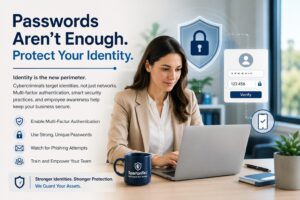
Cybersecurity professionals often say, ‘Identity is the new perimeter.’ Employees now access Microsoft 365, Google Workspace, accounting software, and cloud applications from virtually anywhere. Protecting those identities is just as important as protecting your office network.
Multi-Factor Authentication (MFA) is one of the simplest and most effective ways to reduce cyber risk. Even if someone steals a password, they still need the second verification step before gaining access. MFA is one of the foundational protections included in SpartanTec’s SecureGuard360 approach. [Internal Link – SecureGuard360]
Strong passwords should also be unique for every account. Password managers make this easier while reducing password reuse. Combined with proactive Managed IT Services, ongoing monitoring, and regular security reviews, they help create a much stronger security posture.
Modern cybersecurity is built in layers. Email security, endpoint protection, security awareness training, backups, software updates, and proactive monitoring all work together. No single tool protects your organization by itself, but together they dramatically reduce risk.
Technology is only part of the solution. Employees who recognize suspicious emails and know when to pause before clicking a link often prevent incidents before they ever become a problem.
The SpartanTec Perspective
At SpartanTec, we believe effective cybersecurity starts with protecting identities—not just devices.
Our security-first approach combines Multi-Factor Authentication, Microsoft 365 and Google Workspace security, endpoint protection, email security, proactive monitoring, employee awareness training, and continuous management. Together, these layers help businesses, nonprofits, charter schools, municipalities, CPA firms, law firms, and other organizations throughout North and South Carolina reduce risk while staying productive.
Technology should support your organization—not become a daily concern.
Frequently Asked Questions
If I have a strong password, why isn’t that enough anymore?
Because passwords are often stolen through phishing, malware, fake login pages, or data breaches rather than guessed.
How are passwords usually stolen?
Most are stolen through phishing emails, fake websites, password reuse, malware, or previous data breaches.
What is Multi-Factor Authentication?
MFA adds a second verification step before granting access.
Does every small business need MFA?
Yes. It is one of the most effective ways to reduce unauthorized access.
Is antivirus enough?
No. Modern cybersecurity also includes email security, identity protection, endpoint protection, awareness training, backups, and monitoring.
Should we use a password manager?
Yes. Password managers encourage unique, complex passwords and reduce password reuse.
How often should employees receive awareness training?
Regularly throughout the year as threats evolve.
What should we do first?
Enable MFA, review administrator accounts, use password managers, keep systems updated, and train employees.
What is Zero Trust?
A security approach that continuously verifies users and devices instead of automatically trusting a password.
How can SpartanTec help?
SpartanTec provides layered cybersecurity, proactive monitoring, Microsoft 365 and Google Workspace security, awareness training, and managed IT services.
Continue the July Series
Week 1: How AI Is Changing Cybersecurity for Businesses
Week 2: The Best Technology Is the Technology You Rarely Notice
Coming Next: The Hidden Cost of Waiting Until Something Breaks
If you’d like to review your Microsoft 365 or Google Workspace security, discuss Multi-Factor Authentication, or compare your current cybersecurity strategy with industry best practices, schedule a 10 minute Discovery Call with SpartanTec.

