

By: Lisa Carter, President, SpartanTec, Inc.
What Should Be in an Incident Response Plan? Key Components Explained
Learn what an effective incident response plan should include, why most plans fail, and how to prepare your organization for real-world cyber incidents.
What should be included in an incident response plan?An incident response plan should include defined roles and responsibilities, incident classification, communication procedures, containment and recovery steps, documentation requirements, and a process for ongoing testing and improvement.
What an Incident Response Plan Should Actually Include
Many organizations focus on tools but overlook how their team will actually respond during an incident.
Here’s why incident response training matters more than most organizations realize → https://www.spartantec.com/2026/05/01/why-incident-response-training-matters-more-than-your-security-tools/
Why Most Incident Response Plans Fail
Most incident response plans fail because they are too complex, too vague, or never tested.
Common issues include:
- Roles and responsibilities are unclear
- No defined first step
- Communication is not planned
- The plan has never been practiced
When an incident occurs, teams don’t have time to interpret a document. They need clarity.
What Are the Key Components of an Incident Response Plan?
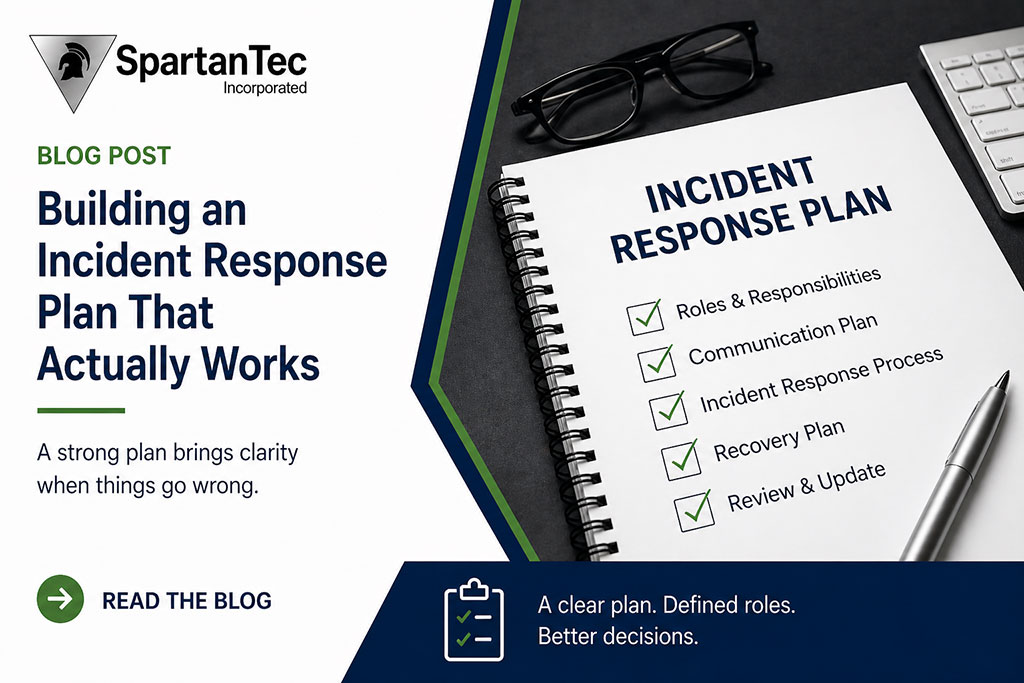
An effective plan should include the following:
1. Roles and Responsibilities
Every incident response plan should clearly define who is responsible for what.
This includes:
- Decision-makers
- Technical responders
- Communication leads
Without this, response time slows and confusion increases.
2. Incident Classification
Not every alert is an incident—but some require immediate action.
Your plan should define:
- What qualifies as an incident
- Severity levels
- Escalation thresholds
3. Communication Plan
Communication is often where incidents break down.
Your plan should address:
- Internal communication flow
- Customer or vendor notifications
- Regulatory or legal considerations (if applicable)
4. Containment and Recovery
Speed matters—but so does doing it correctly.
Your plan should outline:
- When to isolate systems
- How to prevent spread
- How to restore operations safely
5. Documentation and Reporting
Documentation is critical for both compliance and improvement.
This includes:
- Logging actions taken
- Preserving evidence
- Creating post-incident reports
6. Testing and Continuous Improvement
One of the most effective ways to test your plan is to walk through a real-world scenario with your team.
Here’s how tabletop exercises help identify gaps before an incident occurs → https://www.spartantec.com/2026/05/01/tabletop-exercises-the-safest-way-to-experience-a-cyber-attack/
Organizations should:
- Conduct tabletop exercises
- Review the plan regularly
- Update it after major changes
If you’re not sure whether your current plan covers these areas, we put together a simple Incident Response Readiness Checklist to help you quickly identify gaps.
It walks through:
- Roles and responsibilities
- Communication planning
- Testing and training
- Ongoing readiness
Who Should Own the Incident Response Plan?
Incident response should not be owned by IT alone.
While IT executes much of the response, leadership must be involved in:
- Decision-making
- Communication
- Business impact assessment
Cyber incidents affect the entire organization.
How Often Should an Incident Response Plan Be Updated?
Incident response plans should be reviewed at least annually or after major changes.
Update your plan when:
- Systems or infrastructure change
- Staff roles change
- New risks or threats emerge
Want to Strengthen Your Incident Response Approach?
- Why incident response training is critical → https://www.spartantec.com/2026/05/01/why-incident-response-training-matters-more-than-your-security-tools/
- How tabletop exercises help identify gaps → https://www.spartantec.com/2026/05/01/tabletop-exercises-the-safest-way-to-experience-a-cyber-attack/
The Bottom Line
A plan that sits on a shelf is not a plan—it’s a liability.
Organizations that respond effectively:
- Have clear processes
- Train their teams
- Continuously improve
FAQ Section
What should be included in an incident response plan?
An incident response plan should include roles and responsibilities, communication procedures, incident classification, containment steps, recovery processes, and ongoing testing.
Why do incident response plans fail?
They often fail because they are too complex, unclear, or never tested. Without practice, teams struggle to follow them during real incidents.
How often should an incident response plan be updated?
At least once per year, or after major changes to systems, staff, or risk exposure.
Who is responsible for incident response in a business?
Incident response involves IT, leadership, and key departments like operations and HR. It is a shared responsibility across the organization.
What is the first step in an incident response plan?
The first step is identifying and confirming that an incident has occurred, followed by initiating the response process and notifying the appropriate team members.
Not Sure If Your Incident Response Plan Is Complete?
Most organizations don’t realize what’s missing until they walk through a real scenario.
Start by identifying gaps in your current approach.
Download our Incident Response Readiness Checklist to:
- Evaluate your current plan
- Identify areas for improvement
- Prioritize next steps
If you’d prefer to walk through it together, SpartanTec helps organizations:
- Build practical incident response plans
- Conduct training and tabletop exercises
- Provide ongoing cybersecurity and IT support
Schedule a Discovery Call: https://www.spartantec.com/discoverycall/

