

Quick Answer: What Do Businesses Need Before Renewing Cyber Insurance?
Before renewing cyber insurance, businesses must demonstrate that they have strong cybersecurity controls in place, including:
- Multi-factor authentication (MFA)
- Endpoint protection and monitoring
- Tested backup and recovery systems
- Access control policies
- Email security and user awareness training
Insurers are increasingly requiring proof—not just confirmation—that these controls are active and effective.
Why Cyber Insurance Requirements Have Changed
Cyber insurance carriers have significantly tightened requirements due to the rise in ransomware and data breaches.
Today, it’s not enough to say protections are in place—organizations must show that they are properly configured, monitored, and maintained.
Without this, businesses may face:
- Higher premiums
- Coverage exclusions
- Delays in policy approval
- Denied claims after an incident
The Most Common Issues Found Before Renewal
As renewal periods approach, many organizations discover gaps they weren’t aware of.
The most common include:
-
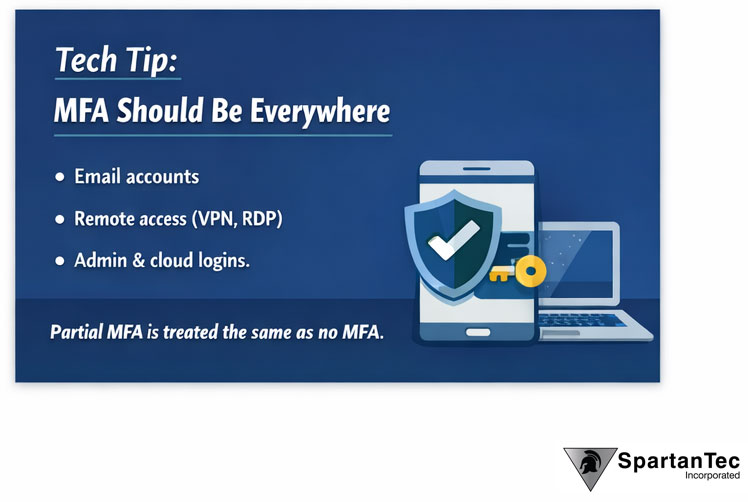
MFA Is Incomplete or Inconsistently Enforced
While MFA may be enabled in some areas, insurers expect it to be enforced across:
- Email systems
- Remote access (VPN/RDP)
- Administrative accounts
Partial implementation is often treated the same as no implementation.
-
Backup Systems Are Not Verified
Having backups is not enough.
Insurers increasingly expect:
- Regular backup testing
- Documented recovery processes
- Separation from the primary network (to prevent ransomware impact)
-
Lack of Active Monitoring and Response
Many organizations have security tools in place—but no one is actively monitoring alerts.
Insurers want to see:
- Continuous threat monitoring
- Incident response capability
- Defined escalation processes
-
Excessive or Uncontrolled User Access
User access is a major factor in cyber risk.
Common issues include:
- Shared accounts
- Unused or outdated accounts
- Over-permissioned users
These are red flags during underwriting.
-
Limited Documentation and Visibility
Even if controls exist, organizations often lack:
- Clear documentation
- Evidence of enforcement
- Visibility into system activity
Without this, proving compliance becomes difficult.
What Insurers Are Really Evaluating
Cyber insurance providers are not just checking boxes.
They are evaluating whether your organization can:
- Prevent common attacks (like phishing and credential theft)
- Detect suspicious activity quickly
- Respond effectively to incidents
- Recover operations without significant disruption
In other words, they are assessing your real-world resilience—not just your technology stack.
How to Prepare Before Renewal
To avoid surprises during renewal, organizations should review:
- MFA coverage across all critical systems
- Backup integrity and recovery testing
- Security monitoring and alert response processes
- User access controls and account management
- Documentation of policies and procedures
Addressing these areas early can prevent last-minute scrambling and reduce the risk of increased premiums.
How Do You Know If You’re Ready?
You’re likely ready for renewal if you can confidently answer:
- Is MFA enforced across all key systems?
- Have we tested our backups recently?
- Are security alerts actively monitored and reviewed?
- Do we know who has access to critical systems?
- Can we demonstrate these controls if asked?
If any answer is uncertain, preparation is needed.
Why Many Businesses Struggle at Renewal Time
Cyber insurance requirements often expose gaps that have developed over time.
Common challenges include:
- Incremental IT changes without a structured review
- Lack of internal resources to manage security continuously
- Overreliance on tools without active oversight
This leads to reactive efforts just before renewal—when time is limited.
How Managed IT Services Simplify Cyber Insurance Compliance
A proactive managed IT partner helps organizations:
- Align systems with insurance requirements year-round
- Maintain documentation and visibility
- Monitor and respond to threats continuously
- Prepare for renewals without last-minute stress
This approach reduces uncertainty and improves outcomes with insurers.
Final Thought: Renewal Is a Checkpoint—Not the Goal
Cyber insurance is an important layer of protection.
But the real objective is ensuring your business can operate securely and recover quickly from disruptions.
A smooth renewal process is often a reflection of a well-managed IT environment—not a last-minute effort.
Call to Action
At SpartanTec, we help organizations prepare for cyber insurance renewals by identifying gaps and aligning IT environments with current requirements.
If your renewal is approaching, now is the time to review where things stand.
FAQ
What are cyber insurance requirements for businesses?
Common requirements include MFA, endpoint protection, backup validation, monitoring, and access control policies.
Can a cyber insurance claim be denied?
Yes. Claims can be denied if required security controls were not properly implemented or maintained.
How early should businesses prepare for renewal?
At least 60–90 days in advance to allow time for remediation and documentation.
What is the biggest mistake businesses make with cyber insurance?
Assuming controls are in place without verifying or documenting them.

