

By Lisa Carter, President of SpartanTec
Technology failures rarely start with technology
When business leaders think about IT risk, the focus is often on hardware, software, or cybersecurity tools. Yet in most real-world incidents—downtime, breaches, compliance findings, or financial fraud—the root cause is not the technology itself.
It is lack of visibility.
Organizations cannot protect what they cannot see. When leaders lack clear insight into systems, access, data movement, or emerging threats, problems grow quietly until they become urgent, expensive, and public.
What visibility really means for leadership
Visibility is not a technical dashboard. It is decision clarity.
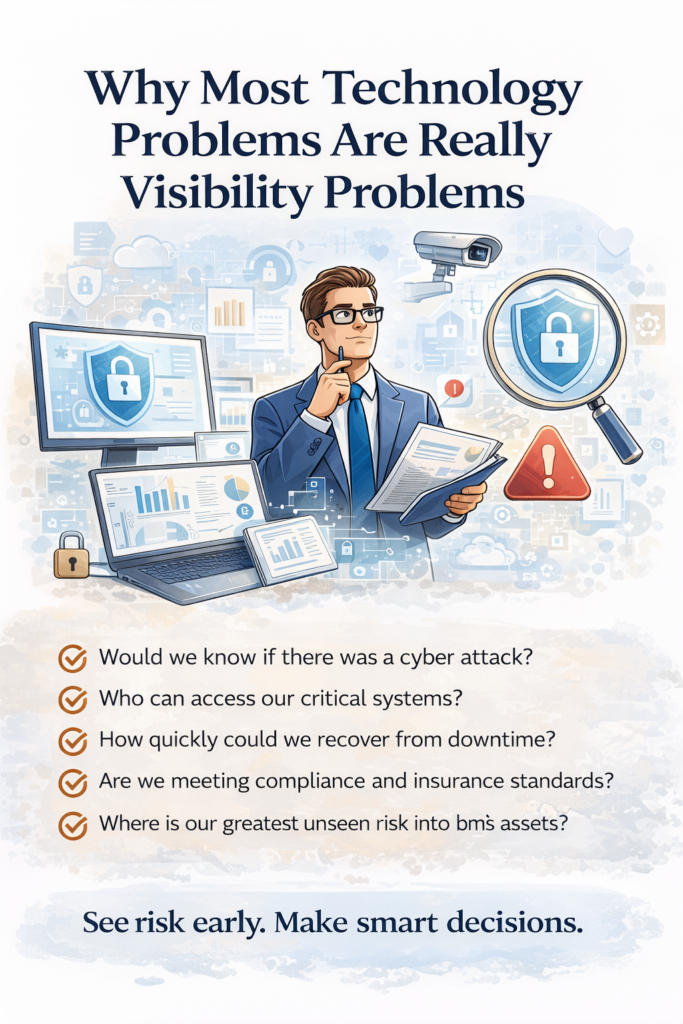
Executives and directors need answers to key questions:
• Would we know if a cyber incident started today?
• Who has access to sensitive systems and data?
• How quickly could we recover from downtime?
• Are we meeting compliance and insurance expectations?
• Where is our greatest unseen risk right now?
When those answers are unclear, technology risk becomes business risk.
The hidden pattern behind most incidents
Across municipalities, CPA firms, schools, nonprofits, and growing businesses, a common pattern appears:
1. Something changes.
2. Visibility does not keep up.
3. An incident exposes the gap.
Leaders often respond the same way: “We didn’t realize that could happen.” This reflects a visibility failure, not a technology failure.
Why visibility is now a leadership responsibility
Cybersecurity and operational resilience directly impact financial stability, public trust, regulatory compliance, insurance coverage, and organizational reputation. Because of this, boards and executives are expected to demonstrate reasonable oversight of technology risk—even without deep technical expertise.
Signs your organization may have a visibility gap
- Confidence based on “nothing bad has happened yet.”
• Uncertainty about recovery timelines.
• Limited insight into user access or vendor connections.
• Backups that exist but are rarely tested.
• Security alerts without real response.
• Cyber insurance requirements that are unclear.
Together, these often signal hidden risk leadership cannot fully see.
What strong visibility looks like
- Continuous monitoring with real human response.
• Clear understanding of access, data, and system dependencies.
• Tested backup and recovery processes.
• Documented incident response ownership.
• Alignment with compliance and cyber insurance expectations.
• Leadership-level reporting translated into business terms.
These outcomes depend on clarity—not a single product.
The leadership advantage of seeing risk early
Visibility prevents crises and improves decision-making by increasing confidence, reducing surprises, accelerating recovery, protecting trust, and strengthening conversations with boards, auditors, and insurers.
A simple question every leader should ask
How would we know if something was wrong today—and what would happen next? The clarity of that answer often determines the resilience of the entire organization.
Moving from uncertainty to confidence
Organizations that succeed in changing environments are not those with the most technology, but those with the clearest visibility—enabling calm, confident, and timely leadership decisions.
Final thought
Most technology problems are not surprises. They are simply problems we could not see soon enough. Improving visibility is often the fastest path to stronger cybersecurity, smoother operations, and better leadership confidence.
Frequently Asked Questions (FAQ)
What is technology visibility?
Technology visibility is the ability for leadership to clearly understand systems, access, risks, and recovery capabilities across the organization in real time.
Why does lack of visibility increase cybersecurity risk?
When organizations cannot see threats, vulnerabilities, or unusual behavior early, incidents grow undetected and become more damaging, expensive, and disruptive.
Is visibility only a technical IT concern?
No. Visibility directly impacts financial stability, compliance, insurance coverage, public trust, and operational continuity—making it a leadership responsibility.
How can organizations improve technology visibility?
Improvement typically includes continuous monitoring, tested backups, clear access controls, incident response planning, and leadership-level risk reporting in plain language.
What is the first step leaders should take?
Leaders should start by asking: ‘How would we know if something was wrong today—and what would happen next?’ The clarity of that answer reveals current visibility gaps.

