

By Lisa Carter, President of SpartanTec
Cybersecurity & Business Continuity for Organizations
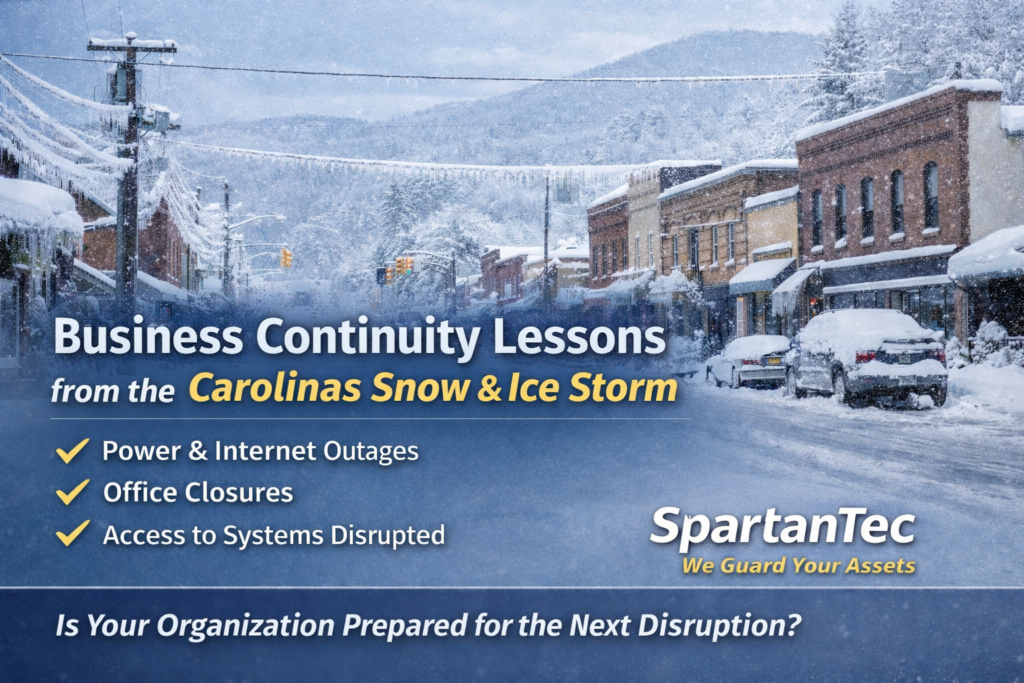
Last week’s snow and ice across western North Carolina and South Carolina provided a real-world example of how quickly business operations can be disrupted. Office closures, hazardous travel conditions, and power or internet outages left many organizations unable to operate as planned. While some businesses adapted with minimal interruption, others struggled to access systems, files, phones, and applications that are critical to daily operations.
What made this event particularly instructive is that it wasn’t caused by a cyberattack. There was no ransomware, no data breach, and no malicious activity. Yet the business impact felt familiar. Productivity slowed or stopped, customers were affected, and leadership teams had to make fast decisions with limited visibility. From a business continuity perspective, the source of the disruption mattered far less than its effect.
Business continuity planning is often associated with cybersecurity incidents, but weather events like this highlight a broader reality. Downtime impacts organizations the same way whether it stems from severe weather, power failures, internet outages, hardware issues, or cyber incidents. When systems are unavailable, operations suffer and pressure shifts quickly to leadership.
During the storm, many business owners across the Carolinas asked practical questions in real time. What if the office can’t reopen tomorrow? What if employees can’t safely travel but still need system access? What if internet service is unavailable for multiple days? What if phone systems or line-of-business applications are unreachable? And critically, who is responsible for making decisions as conditions evolve?
These are business continuity questions—not IT problems.
Many organizations assume they are prepared because they use cloud services, allow remote work, or maintain backups. In practice, disruptive events often expose gaps. Remote access may work for some roles but not others. Backups may exist without clear recovery timelines. Critical systems may rely on a single location, device, or service provider. Decision ownership may be unclear when normal operations are disrupted.
Effective business continuity planning isn’t about adding more technology. It’s about understanding how systems perform under stress and whether IT support aligns with how the business actually operates. It requires leadership to ask realistic “what if” questions and define how the organization would respond before disruption occurs.
Weather events like last week’s storm offer a valuable opportunity to evaluate preparedness without the added complexity of a cyber incident. They allow organizations to assess assumptions, identify weaknesses, and determine whether they would be comfortable if the disruption lasted longer or occurred during a more critical time.
What if the next disruption lasts longer? How would your organization respond?
SpartanTec works with organizations across North and South Carolina to help align IT support with real-world business continuity needs. If last week’s weather raised questions—or confirmed concerns—we’re happy to schedule a conversation to review what it revealed and how to prepare for future disruptions.
Preparedness shouldn’t start during the outage.
While last week’s winter weather affected organizations across the Carolinas, the operational impact of downtime varies by industry. Business continuity planning works best when it aligns with how each organization delivers services, supports staff, and meets obligations.
Rather than treating continuity as one-size-fits-all, SpartanTec helps organizations apply practical IT support strategies based on real operational needs.
Municipalities & Local Government
For municipalities, continuity planning focuses on maintaining essential services, supporting staff during closures, and ensuring leadership and departments can access critical systems when offices are unavailable.
Nonprofits
Nonprofits often rely on small teams and shared systems, making downtime especially disruptive to programs and donor engagement. Business continuity planning helps ensure access to systems and communication tools remains available during unexpected events.
K–12 Charter Schools
For charter schools, closures can disrupt far more than instruction. Administrative access, finance systems, compliance reporting, and communication with families all depend on stable technology—even when buildings are closed.
CPA Firms & Professional Services
CPA firms and professional services organizations face strict deadlines and regulatory requirements. Downtime during weather events can delay filings, disrupt workflows, and increase compliance risk.
Small & Mid-Sized Businesses
For small and mid-sized businesses, downtime often translates directly into lost revenue and productivity. Business continuity planning helps ensure systems remain accessible—or recover quickly—when disruptions occur.
A practical way to assess visibility, risk, and operational readiness across systems, users, and vendors.
🔗 https://www.spartantec.com/secureguard360/
If you’d like to talk through how this applies to your organization, you can reach us at 843-418-4792 or schedule a time to connect here: https://go.scheduleyou.in/y7Iay5
Frequently Asked Questions
What is business continuity planning?
Business continuity planning is the process of preparing an organization to continue operating during disruptions such as severe weather, power outages, internet failures, system downtime, or cyber incidents. It focuses on maintaining access to critical systems, communication, and decision-making when normal operations are interrupted.
How is business continuity different from disaster recovery?
Disaster recovery focuses on restoring IT systems after an outage or failure. Business continuity is broader and includes people, processes, communication, and decision ownership. Disaster recovery is one part of a complete business continuity plan.
Does business continuity planning include weather events?
Yes. Weather-related disruptions such as snow, ice, hurricanes, and storms are common causes of downtime in North and South Carolina. Business continuity planning addresses these scenarios alongside cyber incidents and infrastructure failures.
How often should business continuity plans be reviewed?
Business continuity plans should be reviewed annually and whenever there are major changes to systems, staffing, vendors, or business operations. Real-world events, such as recent weather disruptions, are also an ideal time to reassess readiness.

